🐋 THE CHILD WHO COULD NOT WAKE HER: The Heartbreaking True Story of Baby Whale Orphans — And What Scientists Found 3 Months Later
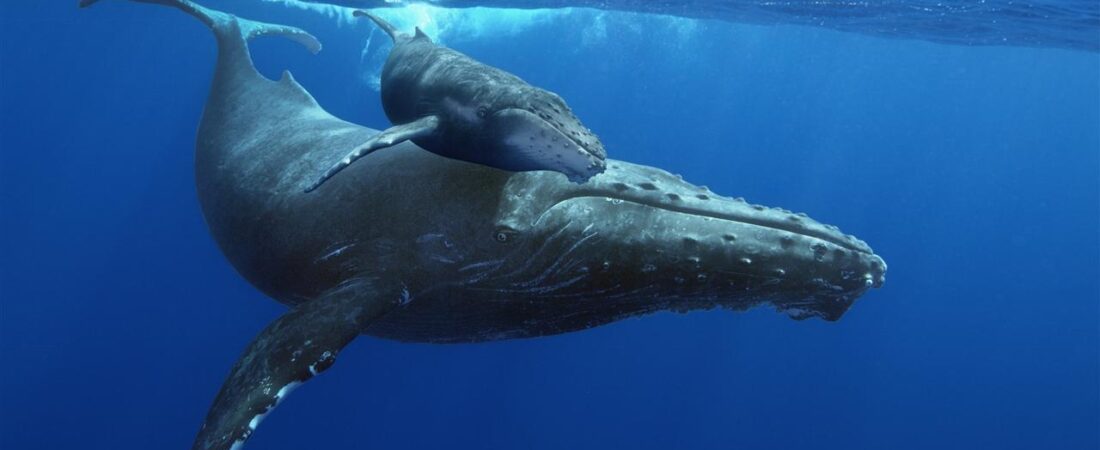
In the warm waters off the coast of Hawaii, a research team filmed something they wish they had never seen.
A humpback whale calf, no more than 1 year old, was swimming in slow circles around something massive and still. As they came closer, they realized what it was.
It was his mother.
She was dead.
He didn’t know.
🐋 The Behavior That Broke Their Hearts
For the next 9 days, the team watched as the baby whale refused to leave his mother’s side. He pressed his small head against her body, trying to wake her. He swam under her, lifting her gently with his back — the way she had once lifted him to teach him to breathe.
He did this thousands of times.
He vocalized — high, mournful calls that the scientists later described as sounding like a child crying.
Other humpback whales passed through the area. They sang to him. They circled. They tried to lead him away.
He would not follow.
He stayed with her until her body began to sink. And when she sank, he followed her down — until the water grew too deep, and he had to return to the surface to breathe.
Then he came back. And he started again.
🔬 Why This Is So Devastating
Humpback whale calves depend on their mothers for 1 to 3 years. They drink up to 600 liters of milk per day. They follow her on a 5,000-mile annual migration. She teaches them how to:
Hunt for krill
Use bubble-net feeding
Communicate with the family
Navigate using ocean currents and magnetic fields
Sing the songs that identify their pod
Without her, a calf this young has almost no chance.
The science is brutal: of orphaned humpback calves under the age of 1, an estimated 90% die within 6 months. Some starve. Some get lost during migration. Some are taken by predators they were never taught to avoid.
But many simply… give up. They stop eating. They stop swimming. They sink into the deep, choosing to follow the only family they ever knew.
This is what marine biologists now call “whale grief.” And the science of cetacean mourning is becoming impossible to deny.
💔 What the Rescue Team Tried to Do
When the research team realized the calf was orphaned, they alerted the Hawaiian Marine Mammal Rescue Network. A specialized team arrived within 48 hours with a plan to feed him a milk substitute and slowly guide him toward another nursing pod.
It had been done once before, in 2019, with limited success.
For the first day, the calf approached the rescue boat. He took some of the milk. The team felt hope.
But the next morning, they found him back at the spot where his mother had been. Even though her body had drifted miles away by then, he had returned. He floated there. He waited.
They tried again. He took less milk. By the third day, he stopped approaching the boat altogether.
Then he disappeared.
🌊 What They Found 3 Months Later
The team returned to Hawaii the following season, hoping — desperately — to spot him with another pod.
They didn’t.
But what they did find, in the same channel where they had first filmed him, was something that has haunted them ever since.
A small skeleton, resting on the sand. His ID — confirmed through tail pattern matching — was unmistakable. He had returned to the place his mother died. He had stopped eating. He had stopped swimming.
He had chosen to be with her.
The researcher who led the expedition, a woman who had spent 30 years studying humpback whales, told the local newspaper through tears:
“We always knew whales had grief. We just didn’t know how deep it could go. He didn’t die from starvation. He died from a broken heart. He never wanted to be anywhere she wasn’t.”
💛 Why We Need to Talk About This
In 2026, we are still losing thousands of whales every year to:
🚢 Ship strikes
🎣 Ghost nets and entanglement
🌡 Climate change reducing food sources
🛢 Ocean noise pollution from naval sonar
☠️ Industrial pollution affecting milk quality
Every time a mother whale dies, it is not just one life lost. It is often two. Or more. Because in the world of whales, family is not a word. It is the only reason to keep swimming.
We owe them more than we are giving them.
We owe them oceans they can survive in. We owe them migration routes that aren’t littered with our garbage. We owe them silence in the depths where they once heard each other across thousands of miles.
We owe them mothers who get to grow old.
🐋 He Was 1 Year Old. He Did Not Know How to Be Alone.
But maybe — through this story — we can make sure another calf doesn’t have to learn what he did.
If this moved you, please share it. Tag someone. Donate to whale conservation. Demand slower ship lanes. Refuse single-use plastics.
Because somewhere right now, another baby whale is swimming next to his mother — and she is alive, and she is teaching him, and they are happy.
Let’s keep them that way. 🌊💛
📚 Sources
Pacific Whale Foundation — Humpback Calf Behavior Studies
Journal of Marine Biology (2024) — “Mortality rates in orphaned humpback calves”
Hawaiian Marine Mammal Rescue Network — Field Reports
Smithsonian Magazine — “The Grieving Whales of Hawaii”
💬 Tell Us in the Comments
What is the love that has held YOU together — even when the world tried to break you?
Leave a 🐋 below if his story moved you. And share this to remind someone that mothers — of any species — deserve to grow old.