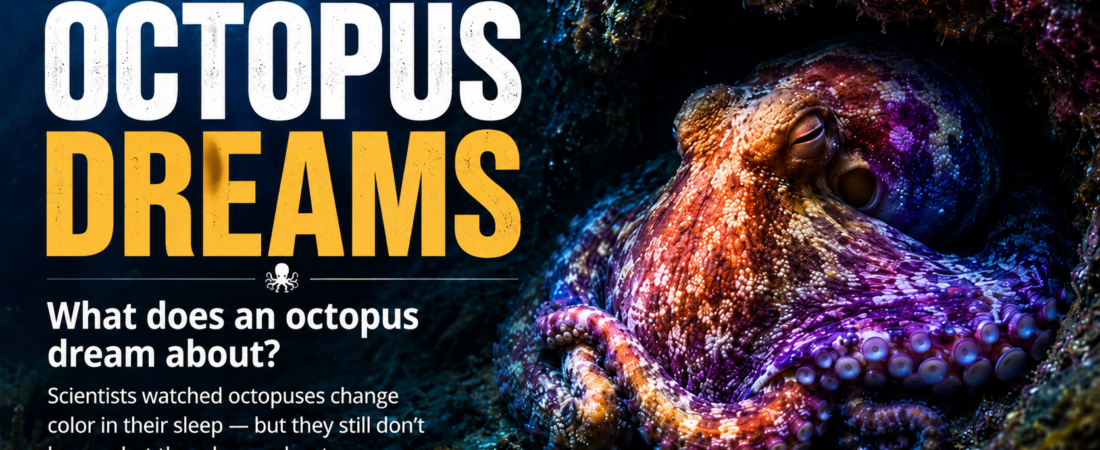
In a quiet research lab in Alaska, an octopus was sleeping.
Her name doesn’t matter. She was one of many cephalopods Dr. David Scheel had studied over his career at Alaska Pacific University — a marine biologist who had spent decades trying to understand what these strange, eight-armed creatures actually experience in their inner lives.
For most of human history, we have assumed they don’t experience much.
Octopuses are mollusks. Closer to snails than to mammals. Their brains evolved on a completely different branch of life than ours, about 500 million years ago. They have no spine. No central nervous system the way we understand it. Two-thirds of their neurons are in their arms, not their head.
For a long time, scientists believed they were essentially biological machines. Sophisticated. Beautiful. But without anything we would call an inner world.
Then, in 2019, Dr. Scheel set up a camera in his lab and let it run while one of them slept.
What he captured changed everything.
What the camera saw
She was resting on the floor of her tank. Eight arms tucked beneath her. Eyes closed. Breathing slow and steady — the way octopuses do when they enter their version of deep sleep.
For the first few minutes, she was completely still. Her skin was a soft, calm beige.
Then her skin started to change.
Slowly at first. A wave of dark brown spread from her head down toward her arms — the same pattern octopuses use when they are alert. When they are watching. When they are about to react to something in their environment.
But she wasn’t watching anything. Her eyes were closed.
The color shifted again. Now yellow spots appeared on her skin — the camouflage pattern octopuses use to blend in with sandy ocean floors.
Then the most striking change of all.
A deep, aggressive red began to ripple across her body. Her arms twitched. The pattern was unmistakable to anyone who has studied these animals.
It was the color octopuses turn when they are hunting.
Her eyes never opened.
She was hunting in her sleep.
What he thinks she was dreaming about
When Dr. Scheel watched the footage back, he wasn’t sure what to say at first.
What he was seeing — and you can see it too, in the documentary footage that has since gone viral — looked exactly like a memory being replayed. The kind of dream where you wake up with your heart racing because you were running from something. The kind of dream where your body twitches because your brain is acting out a story.
In an interview with the New York Times, Scheel said carefully:
“If she is dreaming, this is a dramatic moment.”
He didn’t say she was definitely dreaming. He has been a scientist too long to be careless with words. But he did say what the footage suggested.
His theory is this: octopuses, like mammals and birds, may experience a primitive form of REM sleep — the deep sleep stage when humans dream. And when they cycle into that state, their skin betrays what their brain is doing. The color patterns aren’t random. They match real situations from her waking life.
She is dreaming about hunting because she had hunted that day. Or the day before. Or somewhere in the deep memory of her short, intense life.
And when the dream got vivid enough — when her brain replayed a moment that mattered — her body responded the only way it knew how. With color.
The color you saw on the screen is what her dream looked like, from the outside.
What we still don’t know
Here is the part that scientists are most honest about.
We don’t know what she was actually experiencing.
Did she see images, the way we do in our dreams? Or did she experience the dream as a series of feelings, sensations, smells? Her brain is so different from ours that the answer might be something we cannot even imagine.
We don’t know if she was scared, excited, satisfied, or something we don’t have a word for. We don’t know if she remembered the dream when she woke up. We don’t know if octopuses experience nightmares.
We don’t know if she dreamed of food, or escape, or something simpler — just the feeling of water moving against her skin.
We don’t even know if “dreaming” is the right word for what she was doing.
What we know is that something was happening in her mind that mattered enough for her body to respond.
That’s not nothing.
That’s, possibly, everything.
Why this matters
For most of recorded history, humans have placed ourselves at the top of a hierarchy. We have language. We have memory. We have inner lives. We have dreams.
Animals, we said, were beneath us. They had instincts. They had reflexes. They had behavior. But not interior worlds.
The 21st century is slowly taking that hierarchy apart.
We have learned that elephants mourn their dead. That dolphins call each other by name. That magpies recognize themselves in mirrors. That pigs can play video games. That bees can solve puzzles. That trees, in some quiet, slow way, communicate through their roots.
And now an octopus — a creature so alien to us that her ancestors split from ours half a billion years ago — appears to be having dreams.
Not dreams like ours. Probably nothing like ours.
But dreams.
Inner experiences that her brain considers important enough to replay.
What does this mean for how we treat them? For the millions of octopuses caught and eaten every year? For the ones kept in tiny tanks at restaurants and aquariums? For the proposed octopus farms that scientists are now begging governments to ban?
I don’t have an answer.
But I have a feeling that one day, when humans look back at the early 21st century, they will be ashamed of what we did to creatures we didn’t yet understand.
And they will say: they were dreaming. And we knew. And we did it anyway.
The footage
If you want to watch the moment for yourself, search for the documentary “Octopus: Making Contact” on PBS Nature. The scene of the sleeping octopus changing colors is in the first 20 minutes. It has been viewed over 30 million times. It has made people cry. It has changed the way scientists talk about cephalopod intelligence.
It will change the way you look at the ocean.
A small request
If this story moved you, share it with someone who needs to be reminded that we are not the only ones with inner lives.
Somewhere tonight, in an aquarium in Alaska, or in a tank in a research lab, or deep in the cold dark of the Pacific Ocean, an octopus is sleeping.
Her skin is changing.
She is dreaming about something we cannot see.
And maybe, in some small way, she is dreaming about us too.
🌊
About Ocean Giants: We tell the stories of the ocean’s most extraordinary creatures — the whales, dolphins, octopuses, and giants whose lives remind us that the world is bigger and stranger than we ever imagined. Follow us on Facebook for new stories every week. 🐋💙