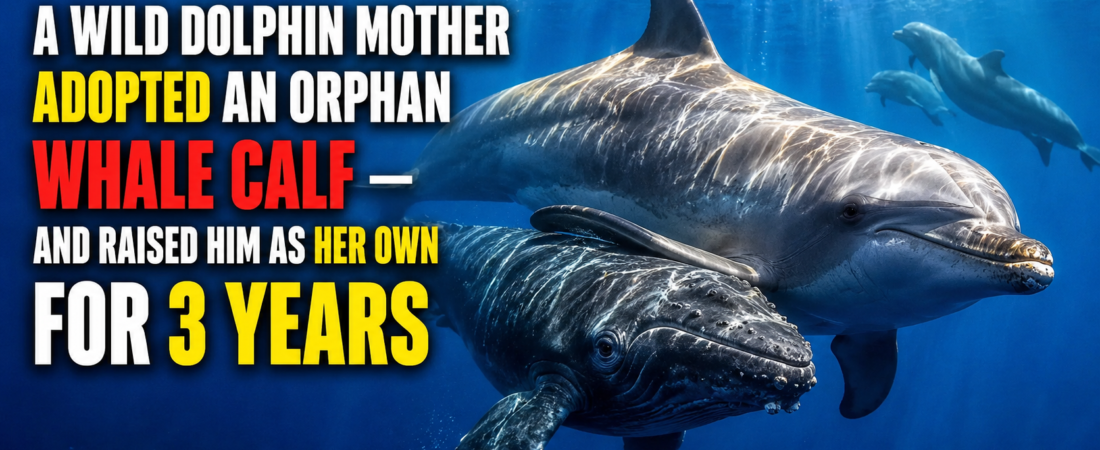
In 2014, researchers in French Polynesia witnessed something that had never been documented before — a wild bottlenose dolphin mother adopting an orphaned whale calf from an entirely different species and raising him for three years.
In 2014, off a remote atoll in French Polynesia, scientists witnessed something they didn’t believe was possible.
A wild bottlenose dolphin mother — already nursing her own newborn daughter — was caring for a second calf.
A male.
A tiny one-month-old, no more than a few weeks separated from his birth.
But his beak was wrong.
Where the dolphin mother’s nose was long and slender, his was short and blunt. He didn’t look like her. He didn’t look like her daughter. He didn’t look like any of the other 30 dolphins in her pod.
For weeks, researchers couldn’t figure out what they were seeing.
Then they realized.
The calf wasn’t a dolphin at all.
He was a melon-headed whale — an entirely different species, from an entirely different genus.
And somehow, this wild dolphin mother had taken him in.
This is the true story of Thaïs and her two children — the first documented case of cross-species adoption in wild dolphins, observed over three years off the coast of Rangiroa Atoll. It was published in the scientific journal Ethology in June 2019 and was reported by National Geographic, IFLScience, and Oceanographic Magazine.
What scientists saw changed how we understand love between species.
Meet Thaïs — The Mother Who Said Yes
In 2009, a research team from the Marine Mammal Study Group of French Polynesia (GEMM) began a long-term study of a community of about 30 bottlenose dolphins living near Rangiroa, a remote atoll in the Tuamotu Archipelago of French Polynesia.
For five years, the researchers watched these animals. They knew them by name. They tracked their family bonds, their feeding routines, their social structures.
One of the females — they called her Thaïs — was an experienced mother. In 2014, she gave birth to a female calf. A normal, healthy newborn bottlenose dolphin, swimming under her mother’s belly the way every dolphin baby learns to do.
But two months later, something appeared in the water beside Thaïs.
Another calf. A male. About one month old.
And he wasn’t hers.
In the wild, bottlenose dolphins have been known to briefly “kidnap” calves from other species — for a few hours, sometimes a few days. It’s not friendly behavior. It’s often aggressive. The calf usually escapes or is abandoned.
That is not what happened here.
This calf stayed.
For three years.
The Calf Who Refused to Leave
Researchers, led by Pamela Carzon of GEMM, watched the unusual pair carefully. From land. From boats. From underwater. They photographed and filmed the trio for months.
What they observed was extraordinary.
The melon-headed whale calf was nursing from Thaïs — drinking her milk, just like her biological daughter. He was swimming beneath her belly in the same protected position calves use. He was playing with the other young dolphins in the pod.
He had been completely accepted.
But the most remarkable part wasn’t what Thaïs did.
It was what the calf did.
He learned to be a dolphin.
Melon-headed whales communicate differently than bottlenose dolphins. They make different sounds. They swim in different patterns. They have different social structures.
But this little orphan — observed for over 36 months between 2014 and 2017 — adopted every behavior of his new family. He surfed in the waves with the other young dolphins. He played their games. He communicated like them.
In Pamela Carzon’s own words, published in National Geographic:
“The melon-headed whale was behaving exactly the same way as bottlenose dolphins.”
He didn’t just become Thaïs’s son.
He became a dolphin.
The Heartbreak Nobody Talks About
There is a part of this story that most articles leave out.
Thaïs had two calves. Her biological daughter — born just before the orphan arrived — and her adopted son.
For a year and a half, the three of them swam together. The mother. The sister. The brother who wasn’t really a brother.
But the orphan was persistent.
Researchers observed him repeatedly shoving Thaïs’s biological daughter away from the prized nursing position under her belly. He wanted to be there. He wanted his mother’s full attention.
After 18 months — well before normal weaning age — the biological female calf disappeared.
We don’t know what happened to her.
We don’t know if she was pushed away. If she gave up. If she went looking for another family and never came back.
We just know that one day, she was gone.
And the orphan whale calf stayed.
For another year and a half, Thaïs raised him alone. Until he was weaned, at around three years old, and finally swam off into the ocean on his own — a melon-headed whale who had been raised as a dolphin, who knew no other family, who carried his adoptive mother’s behaviors with him into the deep.
Why Did She Do It?
This is the question scientists still cannot fully answer.
Cross-species adoption is vanishingly rare in the wild. Until this case, only one other example had ever been documented — when two female capuchin monkeys raised a baby marmoset together in 2006.
But that case had two adoptive mothers sharing the burden. Thaïs did it alone, while caring for her own newborn — an enormous biological cost for a single mother.
Researchers have proposed several theories:
Theory 1: Hormones. Thaïs was already nursing. Her body was flooded with the maternal hormones that drive bottlenose dolphins to nurture. When the orphan presented himself, her biology may have simply responded.
Theory 2: Personality. Carzon’s team noted that Thaïs had an unusually social and accepting personality, even within her pod. She may have been one of the few dolphin mothers temperamentally capable of this.
Theory 3: He chose her. This is the explanation that lingers. The orphan calf was the one who arrived. He was the one who stayed. He was the one who refused to leave. Maybe the question isn’t why Thaïs adopted him — but why he chose her, and how he convinced her to keep him.
We will never know for sure.
What we know is that for three years, a wild dolphin mother in the South Pacific raised a child who shared none of her DNA — and treated him exactly like her own.
What Scientists Believe Happened to the Orphan’s Real Mother
The melon-headed whale calf had to have come from somewhere.
Melon-headed whales are deep-water animals. They live in large pods, often hundreds of individuals strong. They are rarely seen in shallow coastal waters like the ones around Rangiroa.
The most likely explanation: his mother died.
Maybe she was sick. Maybe she was killed by an orca. Maybe she was struck by a boat. We don’t know.
But somewhere out in the deep ocean, a baby whale lost his mother. And instead of dying alone, as most orphaned calves do, he swam toward the first creature that might possibly accept him.
A dolphin family.
A dolphin mother who was already nursing.
And against every rule of the wild — she said yes.
Why This Story Matters
For most of human history, we believed compassion was a uniquely human trait.
We told ourselves that animals operate on instinct, hormones, genetic self-interest. We told ourselves they don’t really feel the way we do. We told ourselves that the love between a mother and a child is a complicated emotional bond that only humans are capable of.
The story of Thaïs is one of the many ways the ocean keeps proving us wrong.
A wild dolphin took in a child who wasn’t hers — who wasn’t even her species — and raised him for three years. She spent her energy, her milk, her time, her body, on a creature with whom she shared nothing.
Except, perhaps, this:
She saw he was alone. And she decided he shouldn’t be.
Maybe that’s all love really is.
Across species. Across borders. Across the deep blue ocean. The instinct to look at something small and lost — and choose it anyway.
Watch the Story
We created a 15-second cinematic short telling stories like this one on Ocean Giants — our community for people who believe animals understand more than we give them credit for.
If Thaïs’s story moved you, share it with a mother who deserves to read it. Somewhere out there, there is a child being raised by someone who didn’t have to choose them — but did anyway.
That is love.
Sources and Further Reading
- Carzon, P. et al. (2019). “Cross-genus adoptions in delphinids: One example with taxonomic discussion.” Ethology, Vol. 125
- National Geographic — “Dolphin mom adopts whale calf — a first” (August 2019)
- IFLScience — “Mother Dolphin Adopts Melon-Headed Whale Calf In The Wild For The Very First Time”
- Oceanographic Magazine — “First known case of adult female bottlenose dolphin adopting whale calf”
- GEMM Polynésie — Marine Mammal Study Group of French Polynesia
About Ocean Giants: We tell the stories of the ocean’s most extraordinary creatures — the whales, dolphins, and giants whose lives remind us that love crosses every border we thought was real. Follow us on Facebook for new stories every week. 🐋💙
Tags: #DolphinMother #MelonHeadedWhale #FrenchPolynesia #MarineBiology #CrossSpeciesAdoption #Compassion #TrueStory #OceanGiants #Motherhood