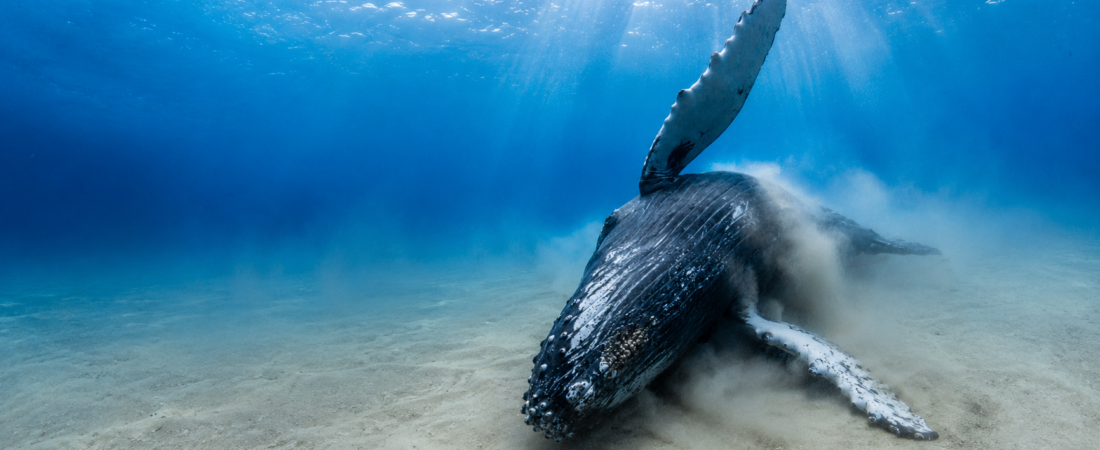
In 2021, marine biologists in Australia accidentally discovered that humpback whales have secret “spas” — sandy bays where they roll on the sea floor to exfoliate. Here’s the full story behind this newly found behavior.
In 2021, marine biologists in Australia were studying how whales migrate.
They didn’t know they were about to discover one of the most surprising whale behaviors of the last century.
Dr. Olaf Meynecke and his team at Griffith University had been attaching tiny video cameras to humpback whales off the Gold Coast of Australia. The tags were meant to track migration patterns — to understand how these 14-meter creatures moved across the ocean, where they fed, where they rested, where they raised their calves.
The footage was supposed to be about geography.
Instead, it showed something nobody had ever recorded before.
The whales were diving down to specific shallow bays. They were lying on their sides on the white sandy sea floor. And they were slowly, deliberately, rolling.
In the words of Dr. Meynecke himself, when he first saw the footage:
“I remember sitting there with my colleagues and we were laughing about it. Like, what?”
The whales had a spa.
And nobody had ever known.
What the Footage Showed
When the research team reviewed video from CATS tags — camera-equipped sensors attached to whales by suction cup — they kept seeing the same pattern.
A whale would descend from the surface, sometimes from depths of up to 49 meters, and approach a sandy patch of seafloor. It would lower its enormous head first into the sand. Then it would slowly roll onto one side. Sometimes it kept rolling — a full rotation, like a person stretching on a beach towel.
The sand rose around them in soft clouds.
The behavior wasn’t quick. It wasn’t accidental. It was deliberate. Each whale spent minutes engaged in this rolling, scraping its massive body against the gritty ocean floor.
And here is what made scientists realize they had found something extraordinary:
The whales did it together.
They weren’t alone. The footage repeatedly showed two whales arriving at the same sandy spots, rolling beside each other, taking turns. Sometimes one would watch while the other rolled. Then they would switch.
It wasn’t just behavior. It was social behavior.
It was a routine they shared.
Why They Do It — The Reason That Will Surprise You
The first time most people learn about this, they assume the whales are just playing. Or scratching an itch.
The truth is more uncomfortable.
Humpback whales are covered in barnacles — hard-shelled crustaceans that attach to their skin and grow there for years. A single adult humpback can carry up to 450 kilograms of barnacles on its body at any given time. They live on the whale’s chin, fins, throat, and especially the underside of their tail.
That’s not all.
Humpbacks are also infested with whale lice — small parasitic crustaceans that look like crabs, embedded between their barnacles and in the folds of their skin. There can be thousands on a single whale.
These parasites aren’t just uncomfortable. They are a serious threat.
In Dr. Meynecke’s own words:
“The whales definitely don’t want those barnacles on them. The swim speed is reduced, and it’s weighing them down.”
Barnacles slow whales down during migration. They create drag. They can lead to infection in the open wounds where they attach. And whales need to constantly shed their skin to stay healthy — but unlike humans, they can’t simply rub against a wall or scratch with their hands.
So they roll in the sand.
The sand is their loofah. The seafloor is their pumice stone. And for thousands — perhaps millions — of years, they have been going to specific places in the ocean to do something that looks remarkably like self-care.
How Scientists Missed This for 200 Years
Humans have been studying whales seriously for over 200 years. Whaling logs from the 1800s. Marine biology research from the 1900s. Documentaries, photographs, drone footage, satellite tracking.
How did we miss this?
The answer is simple and humbling: we never looked from the whale’s perspective.
Until CATS cameras were developed, scientists could only watch whales from boats — from the surface. From above, all you see is a whale diving, then surfacing again 20 minutes later. What happens in between has always been a mystery.
The new tags changed everything. They attach gently with a suction cup, ride on the whale for a few hours, and then pop off and float to the surface where they are retrieved. During those hours, they record the whale’s own point of view — including audio, depth, movement, and high-definition video.
Dr. Meynecke’s team started using these tags in 2019.
It took them two years to spot sand rolling in the footage — partly because there is so much footage to review, and partly because nobody was looking for it. They were studying migration. The spa was an accident.
This is what makes the discovery so important. It is not just about whale skin care. It is about everything we don’t know yet about creatures we thought we understood.
What Scientists Are Afraid Might Happen Next
There is a part of this story that doesn’t get told often — but it matters.
The whales don’t roll just anywhere. They go to specific places.
The research team has identified several spa locations along the Gold Coast and surrounding bays. These spots have particular qualities: shallow water (between 12 and 49 meters), fine white sand or rubble, sheltered from strong currents, and located along the whales’ migration routes.
In other words — they are valuable real estate.
To humans, these places look like nothing more than empty sandy bays. To developers, they look like potential marinas, dredging sites, or shipping channels. To the whales, they are essential rest stops on a 5,000-kilometer migration journey.
In Dr. Meynecke’s own words:
“If we started dredging sand in these areas or if we have a lot of boating activity, well, that means the whales can’t go there or they won’t go there.”
There is currently no special protection for these spa locations. They aren’t marine reserves. They aren’t recognized in coastal planning documents. If a developer decided to build a port in one of these bays tomorrow, there would be no legal reason to stop them.
The whales would simply stop coming.
And the discovery we just made — after 200 years of trying to understand these creatures — would disappear before we even fully understood what it meant.
What This Story Says About Animals
For most of human history, we believed that complex behaviors — preferences, routines, social rituals — were uniquely human.
Then we discovered that humpback whales learn new feeding techniques from each other. That sperm whales have regional dialects. That orcas pass down family traditions across generations.
And now, this.
A humpback whale doesn’t just live in the ocean. She has places she likes to go. She has routines she shares with others. She has things she does for her own well-being — not for survival, not for reproduction, but because they help her feel better.
She has a favorite spa.
This isn’t sentimental projection. It’s documented behavior, published in the Journal of Marine Science and Engineering in 2023, captured on video, observed by an independent research team.
It changes what we are allowed to believe about animals.
Maybe she doesn’t think the way we do. Maybe she doesn’t feel exactly what we feel. But she clearly has a sense that some places are better than others — and that some moments in her long life are for taking care of herself.
That is more than instinct.
That is a kind of wisdom.
Watch the Story
We created a 15-second cinematic short telling this story on Ocean Giants — our community for people who believe the ocean has secrets we are only beginning to understand.
If this story changed how you see whales, share it with someone who needs to remember that the world is more mysterious than we think. Somewhere off the coast of Australia tonight, a 14-meter creature is lying on the sand, rolling slowly, taking care of herself the only way she knows how.
She has been doing this for thousands of years.
We just found out.
Sources and Further Reading
- Meynecke, J.-O., Gustafson, J., & Cade, D.E. (2023). “Exfoliating Whales — Sandy Bottom Contact Behaviour of Humpback Whales.” Journal of Marine Science and Engineering, Vol. 11
- Griffith University News — “Whales stop by Gold Coast bay for day spa fix” (April 2023)
- NPR — “A trip to the newly-discovered undersea spa, where humpback whales go for skin care” (August 2023)
- Phys.org — Whales and Climate Research Program coverage
- Griffith-led Whales and Climate Research Program
About Ocean Giants: We tell the stories of the ocean’s most extraordinary creatures — the whales, dolphins, and giants whose lives remind us that we are not alone, and that the world is bigger and stranger than we will ever fully understand. Follow us on Facebook for new stories every week. 🐋💙
Tags: #HumpbackWhale #WhaleSpa #SandRolling #GoldCoastAustralia #MarineBiology #WhaleBehavior #OceanDiscovery #TrueStory #OceanGiants #GriffithUniversity