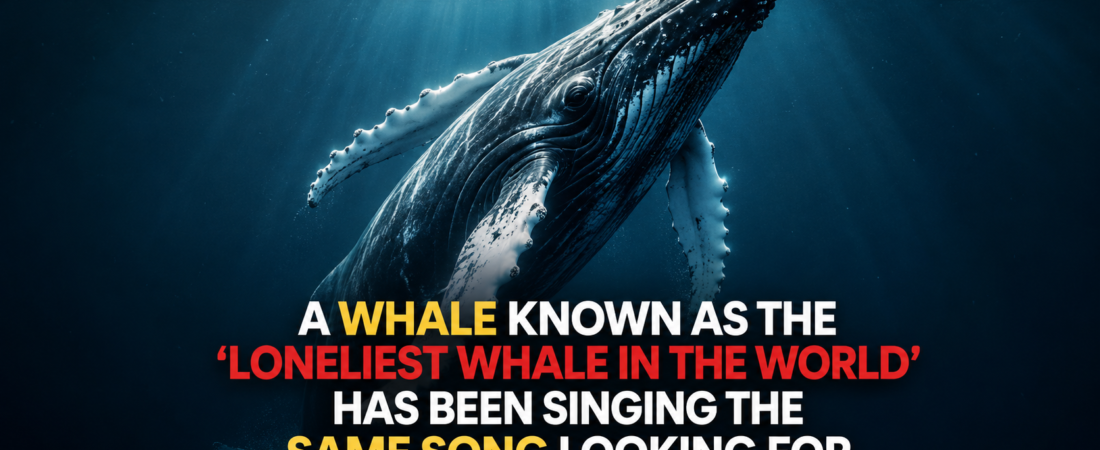
In 1989, U.S. Navy submarine sensors picked up a whale song no other whale on Earth could understand. 35 years later, she is still singing. This is the true story of the 52 Hertz Whale.
A whale is singing in the North Pacific Ocean tonight.
She has been singing the same call for 35 years.
She sings at a frequency no other whale on Earth uses. Not a single one. She has called out across thousands of miles of ocean, every year since 1989, and not one whale has ever answered her.
She has never been seen.
We do not know her age. We do not know what she looks like. We don’t even know her species for certain.
We only know her by her voice.
Scientists call her “52” — after the frequency at which she sings. The world calls her the loneliest whale on Earth.
This is her story.
How the U.S. Navy Accidentally Discovered Her
In 1989, the world was at the end of the Cold War.
The U.S. Navy had built a network of underwater microphones across the Pacific Ocean called SOSUS — the Sound Surveillance System. It was top secret. Its purpose was to listen for Soviet submarines.
It picked up something else.
A sound. Repeating. Coming from somewhere deep in the North Pacific. It wasn’t a submarine. It wasn’t mechanical. It was organic — alive.
It was a whale call.
But it was wrong.
The frequency was 52 Hertz.
Blue whales sing between 10 and 39 Hz. Fin whales sing even lower. The deeper the frequency, the further the sound travels through water. A blue whale’s song can carry across an entire ocean.
But 52 Hertz? Too high. Off the map. Outside the range of any whale species ever recorded.
The Navy didn’t know what it was.
Four years later, in 1993, they shared the recording with Dr. William Watkins, a marine biologist at the Woods Hole Oceanographic Institution.
Watkins listened. And then he listened again.
It was a whale. Just one. Alone.
The Loneliest Song in the Ocean
Watkins tracked her for the next 12 years.
Every year, the same call. Same frequency. Same patterns. She was migrating across the North Pacific — following routes that resembled blue whale migrations, but at the times of year when fin whales travel.
She was alone.
Whales are social animals. Blue whales call across hundreds of miles to find mates. Fin whales gather in feeding groups. Humpbacks sing in chorus during mating season.
This one whale called out to the empty ocean.
And nothing called back.
Other whales swim near her. Scientists have confirmed it. They just cannot hear her. Her frequency is too high for blue whales to recognize as one of their own. Too low for dolphins. Too unusual for anything.
She sings in a language nobody else speaks.
What Scientists Now Believe She Is
For 30 years, we did not know what species the 52 Hertz Whale belonged to.
Then, in 2021, a documentary called The Loneliest Whale: The Search for 52 tracked down evidence that finally answered one of the mysteries.
She is most likely a hybrid — the offspring of a blue whale and a fin whale.
Blue-fin whale hybrids are rare but real. They have been documented since the 1990s. Their bodies are a blend of both parents — and so are their voices. A hybrid whale could naturally sing at a frequency neither parent species uses. A frequency no other whale on Earth could fully recognize.
That would explain everything.
She is not lonely because she chose to be.
She is lonely because she was born between two species — and neither one can fully hear her.
What She Has Lived Through
Try to understand what 35 years means.
She has been singing since 1989. That means while she has been calling out across the empty Pacific:
- The Berlin Wall fell.
- The Soviet Union collapsed.
- The internet was invented.
- Smartphones were created.
- Two wars were fought in the Middle East.
- A global pandemic killed millions.
- Three generations of humans were born, grew up, and grew old.
And she just kept singing.
Every August, she opens her mouth and calls out into the deep dark of the North Pacific.
No one answers.
She closes her mouth, swims on, and waits for next year.
Why Her Story Broke the Internet
The 52 Hertz Whale became a worldwide phenomenon around 2004, when her story first reached the public.
People wrote songs about her. Poets wrote about her. Children drew pictures of her. Tattoo artists inked her image on the skin of strangers who had never seen her face — because nobody has ever seen her face.
She became a symbol.
She became the symbol of every person who ever felt they didn’t quite fit. Every person who ever spoke a language nobody else understood. Every person who ever called out into the dark and heard nothing in reply.
There are entire communities online dedicated to her. People who write her letters. People who pray for her. People who say her story saved their life.
And here is the thing that almost nobody talks about:
She is still alive.
The 52 Hertz call was last detected as recently as 2014. Researchers believe she is still out there. Still singing. Still alive.
If she is a blue-fin hybrid, she could live another 50 years.
She will keep singing for the rest of her life.
She will never know how loved she is.
What Scientists Still Don’t Know
After 35 years of research, here is what we still don’t know about her:
- What she looks like. No human has ever seen her with their own eyes.
- How old she is. Hybrid whales can live 80-100 years. She could be a teenager or an elder.
- If she is the only one. Some hydrophone arrays have picked up similar calls in different locations — which means there may be more than one 52 Hertz whale. They just have never found each other.
- What her song means. It follows the same patterns as blue whale calls — calls that scientists believe are mating songs. So she might be asking, every August, the same question: “Is anyone out there for me?”
That is the part that gets to me.
She is asking. Every year. Just in case.
The Question That Will Stay With You
There is a question I have been thinking about since I first heard her story.
If the 52 Hertz Whale has been singing for 35 years and no other whale has ever responded — what does she think is happening?
Whales are intelligent. They have memory. They have emotion. They form bonds that last decades.
Does she think the other whales have left?
Does she think she is the last of her kind?
Does she still hope?
We will never know.
But somewhere tonight, in the cold dark of the North Pacific, she is opening her mouth. And she is calling out. To no one.
And maybe… that is exactly what makes her story matter.
Because in a world where most of us are surrounded by people who do not understand us — by partners who don’t listen, by families who never saw us, by friends who drifted away — there is a single whale in the ocean who has every reason to stop singing.
And she does not stop.
She just keeps calling.
In case.
Watch the Story
We created a 15-second cinematic short telling her story on Ocean Giants — our community for people who believe the ocean has secrets we are only beginning to understand.
👉 WATCH THE VIDEO ON FACEBOOK →
If her story moved you, share it with someone who has ever felt unheard. Somewhere out there is a whale singing into the dark — and somewhere out there is a person who needed to know they are not the only one
Sources and Further Reading
- Watkins, W. A. et al. (2004). “Twelve years of tracking 52-Hz whale calls from a unique source in the North Pacific.” Deep-Sea Research I, Vol. 51
- Woods Hole Oceanographic Institution — Public Archives on the 52 Hertz Whale
- BBC Earth — “The Loneliest Whale” documentary coverage
- Scientific American — “Inside the Nail-Biting Quest to Find the Loneliest Whale”
- The Loneliest Whale: The Search for 52 (Bleeker Street Films, 2021)
About Ocean Giants: We tell the stories of the ocean’s most extraordinary creatures — the whales, dolphins, and giants whose lives remind us that we are not alone, even when it feels like we are. Follow us on Facebook for new stories every week. 🐋💙
Tags: #52HzWhale #LoneliestWhale #OceanMystery #MarineBiology #DeepSea #NorthPacific #ColdWar #UnsolvedMysteries #TrueStory #OceanGiants