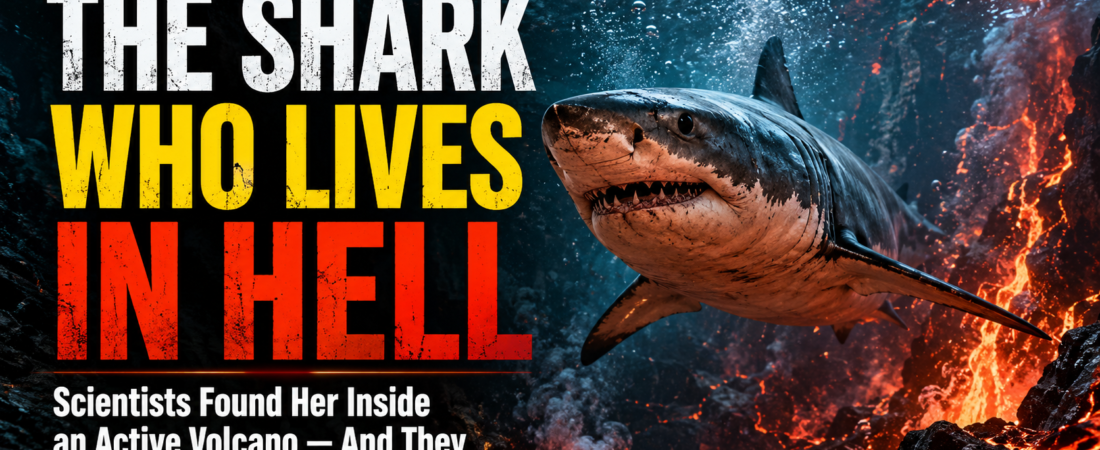
In 2015, a team of marine scientists made a discovery so impossible, they spent days arguing about whether they were really seeing what they thought they were seeing.
Deep beneath the South Pacific Ocean, near the Solomon Islands, lies one of the most violent geological features on Earth: Kavachi. An underwater volcano. Still active. Still erupting. A place where the laws of biology should not apply.
When researchers from National Geographic and the Woods Hole Oceanographic Institution sent a robotic camera down into the crater, they expected to find lifeless rock. Maybe some bacteria clinging to thermal vents. Nothing more.
What they found instead rewrote a chapter of marine science.
🔥 What’s Inside Kavachi?
Imagine a chamber of water hot enough to cook flesh in seconds. Water temperature: 180°F (80°C). Imagine that water saturated with sulfuric acid, methane gas, and clouds of suspended sulfur particles so thick that the camera struggled to focus.
This is not water any creature should be able to enter. Marine biologists call environments like this “extreme exclusion zones” — places where biology shuts down. No fish. No coral. No life.
Except there was life.
Lots of it.
🦈 The Sharks That Should Not Exist
When the camera lights pierced the cloudy, glowing-orange water of the crater, the team saw movement.
A scalloped hammerhead shark — graceful, calm, completely at home — drifted into view.
Then a bull shark appeared behind her. Then another. And another.
They weren’t passing through. They weren’t dying. They weren’t trapped. They were living there. Hunting there. Thriving there — inside an active volcanic crater, in water that should have boiled them alive.
The lead scientist, Brennan Phillips, later told National Geographic in an interview: “We were just blown away by what we saw. These large animals living in what you have to assume is much hotter and much more acidic water, and they’re just hanging out.”
🤯 The Questions Science Still Cannot Answer
It’s been almost a decade since that discovery. And in 2026, despite multiple research expeditions, marine biologists STILL cannot explain:
🔹 How do these sharks tolerate water temperatures that should denature their proteins? The biology textbooks say it should be impossible. Their cells should fail. Their organs should shut down. They don’t.
🔹 How do they breathe in water saturated with sulfur and methane? Hammerheads have highly sensitive gills. The chemistry of Kavachi’s water should poison them within minutes. Yet they breathe normally.
🔹 What happens during major eruptions? Kavachi erupts violently every few years — sending plumes of steam and rock 1.5 kilometers into the sky. Where do the sharks go? Do they die? Do they somehow sense it coming? Do they have a refuge we haven’t found?
🔹 Are they a separate evolutionary line? Some scientists now believe these may be a specially adapted population — sharks whose physiology has evolved over generations to survive what no other vertebrate can survive.
If true, this would be one of the most extraordinary examples of evolution under extreme pressure ever documented.
🌍 Why This Matters Far Beyond Sharks
Kavachi is not just a curiosity. The sharks living inside it are part of a growing list of “extremophile” discoveries that are changing how we understand life itself.
Scientists studying life in places like Kavachi, deep-sea hydrothermal vents, and underground lakes in Antarctica believe these creatures may hold the key to understanding whether life could exist on other planets — moons like Europa or Enceladus, where conditions are far harsher than anything on Earth.
If a hammerhead can live inside a volcano… what else is possible?
💭 The Lesson Hidden in Kavachi
There’s something deeply human about the Kavachi sharks. They live in a place that should kill them. They thrive in conditions that should destroy them. They have made their home in the very place everyone else fled from.
How many of us are surviving our own Kavachi right now?
How many of us are living through fire that other people couldn’t survive — and we don’t even realize how strong we’ve become?
She lives in a volcano. She breathes in poison. She hunts in 180°F water.
And she chose to thrive there.
Maybe she knows something science still doesn’t.
Maybe she’s trying to teach us. 🌋💛
📚 Sources & Further Reading
- National Geographic — “Sharks Discovered Inside Underwater Volcano” (2015)
- Oceanography Magazine — Phillips et al., “Exploring the geology and biology of Kavachi Volcano”
- NOAA Ocean Exploration — Kavachi Volcano Expedition Reports
- Woods Hole Oceanographic Institution — Submersible footage archives
💛 Tell Us in the Comments
If you’re surviving your own “volcano” right now — silently, bravely, alone — leave a 🌋 below.
Let her remind you: where nothing should live, life finds a way. Where everything tells you to give up, you can still choose to thrive.
✨ Follow Ocean Giants for more impossible stories from the deep.